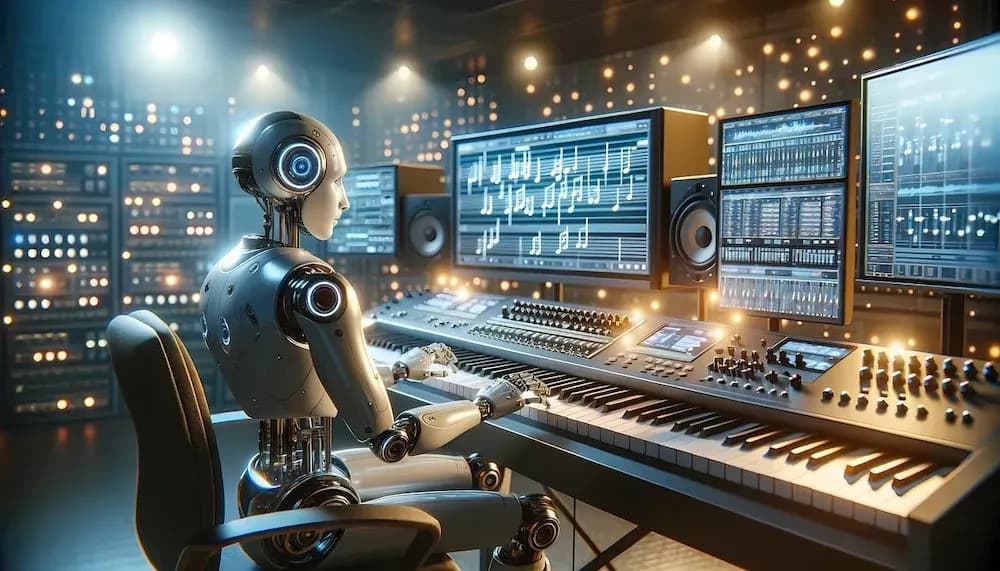
Exploring AI in Music: From Composition to Marketing | Miami
1 - Introduction to AI in Music
- →Historical context and evolution of AI in music
- →Current trends and future prospects
- →Overview of AI technologies in the music industry
2 - AI-Powered Music Composition
- →Hands-on session with AI composition tools
- →Understanding AI algorithms for music composition
- →Case studies of AI-generated compositions
3 - AI in Audio Engineering
- →Automated mastering and mixing with AI
- →Practical applications and tools for audio engineers
- →Utilizing AI for audio processing and enhancement
4 - AI for Music Marketing Tools
- →Personalized recommendation systems
- →AI-driven social media marketing strategies
- →Analyzing data-driven insights for music marketing
5 - AI in Album Art Creation
- →Design principles for AI-generated album covers
- →Generating album artwork using AI algorithms
- →Exploring style transfer and image generation techniques
6 - Generative Music and AI Studio
- →Real-time music AI studio tools
- →Collaborative music production with AI assistance
- →Creating generative music with AI
7 - AI in EDM Production dnd Composition
- →AI-driven tools for synthesizer design and sound manipulation in EDM production
- →Real-time AI-generated effects and beat sequencing techniques for EDM tracks
- →Exploring the intersection of AI technology and Electronic Dance Music (EDM)
8 - Remix and Mashup using AI
- →Future possibilities and trends in AI-driven remixing and mashup creation
- →Introduction to AI-powered remixing and mashup tools
- →Hands-on exploration of AI-driven remixing software and platforms
9 - Ethics and Challenges in AI Music Creation
- →Intellectual property rights and copyright issues
- →Addressing biases and limitations in AI music creation
- →Ethical considerations in AI-generated music
10 - Future Dire¢tions and Conclusion
- →Predictions for the future of AI in the music industry
- →Recap and final thoughts on the course journey
- →Emerging trends and innovations in AI music
Student reviews.
“I work with some of the biggest music producers in the industry on a daily basis. Now I understand how they do what they do.”
Shaun Royer
Instructors


Common questions, answered.
10 classes, each covering lectures, discussions and hands-on activities.
No, though there's a dedicated session on AI in EDM production and composition specifically.
Yes - see AI in Music Private Instruction.
Yes - a full session is dedicated to ethics, intellectual property and bias in AI-generated music.
No - it combines theoretical knowledge, hands-on exercises and case studies to build understanding from the ground up.
AI composition tools, automated mixing and mastering, album art generation, generative music tools, and AI remix/mashup software.
Let's get you started.
InquireWhy Garnish?
Music theory practice, chord progressions, keys and scales
A music production college once asked me to teach music theory and composition - chord progressions, keys and scales, from the ground up.
Read →Scales and Keys
The major and natural minor scale formulas, building any scale from them, relative majors and minors, key signatures, and the circle of fifths as a map of related keys.
Read →Major, minor and extended chords on the keyboard and piano
Music theory practice, part two: major, minor and extended chords on the keyboard, and how to voice them.
Read →Seventh Chords, Extensions and Chord Variations
Major sevenths, minor sevenths and dominant sevenths, ninths, elevenths and thirteenths, sus chords, inversions, and how to make one chord do the work of several.
Read →Songwriting, Music Composition writing chords and bass lines
A last day with a songwriting and composition class - chord sequences, melody, structure, rhythm, lyrics, arrangement and bass lines.
Read →Composition for Producers: Theory as a Tool
Why producers need music theory, which concepts matter most in a DAW, and the exercise that turns a scale into a song in an afternoon.
Read →